

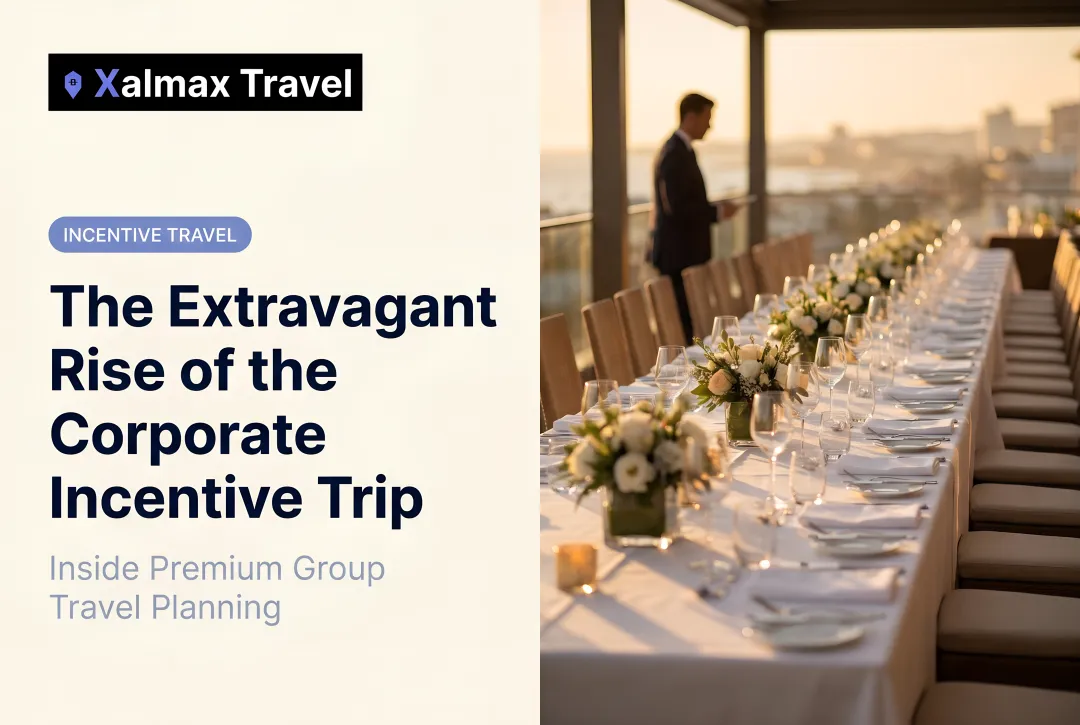
The Rise of Luxury Corporate Incentive Travel: Trends & Best Practices
Introduction
Luxury corporate incentive travel has moved well past the "nice perk" category. For sales leaders, it now sits alongside compensation strategy and performance management as a genuine business tool, one that ties directly to revenue growth, talent retention, and organizational culture.
According to the 2024 Incentive Travel Index, a survey of over 2,800 professionals across 85 countries, 45% of buyers expect incentive travel activity to exceed 2024 levels by 2026, and 55% anticipate per-person spending increases. This guide covers the trends reshaping luxury incentive travel and the practices separating high-impact programs from forgettable ones.
Trend 1: Hyper-personalization
IRF's 2024 attendee preferences research makes the participant mindset clear:
- 91% say group incentive travel to an appealing destination is very or extremely motivating.
- 84.5% say free time to relax is extremely or somewhat important.
- 57% extend their incentive trips before or after the program dates.
- 53% rank bringing a guest or companion as a top-three motivator.
Leading programs build flexibility into every layer: activity menus ranging from adrenaline to restorative options, guest inclusion policies built in from the start, and bespoke gifting featuring artisan goods from the destination. 67% of incentive professionals agree that younger qualifiers will require a significant retool of how incentive travel is designed — and a well-designed experiential program can deliver stronger motivation than cash, which can require up to 3x more spend for the same performance lift.
Trend 2: Wellness, sustainability, and cultural immersion
| Program element | % ranking it among most important |
|---|---|
| Group dining experiences | 51% |
| Group cultural sightseeing | 50% |
| Relationship-building activities | 45% |
| Community service projects | 7% |
| Health and wellness activities | 7% |
Wellness and CSR work best as opt-in enhancements, not centerpieces. Shared meals in extraordinary settings and genuine cultural exploration rank far higher with participants. A private dinner inside a UNESCO World Heritage Site creates story value that drives future performance motivation in a way a resort bubble rarely does.
Trend 3: Exclusivity and the experience arms race
Destinations that felt aspirational a decade ago are now accessible to anyone with a travel budget. The differentiator now is access money alone can't easily buy:
- Full property buyouts — sole occupancy of a boutique hotel or resort.
- After-hours access — private curator tours, restaurant buyouts, front-row experiences from private lounges.
- Deliberately small qualifier groups to create genuine rarity.
- Bespoke keepsakes — commissioned artwork or handcrafted items tied to the destination.
The global average per-person spend is $4,900, with North American programs averaging $5,400, split roughly across hotels (27%), airfare (22%), and food and beverage (18%). 70% of buyers are actively seeking destinations they haven't used before.
What's driving the rise
Remote work eroded the daily informal interactions that build culture and trust — 58% of senior managers now view incentive travel specifically as a culture-building tool. Separately, a 2025 KPMG/University of Melbourne study found 83% of people are concerned about losing human interaction and connection due to AI use. Gallup's research puts voluntary turnover at $1 trillion annually for U.S. businesses — at a $4,900–$5,400 per-person benchmark, the math favors investing in retention programming for high-performing revenue generators.
IRF research shows incentive programs can increase sales performance by 10–20% when designed with clear performance linkages, the clearest case planners can make to finance.
What planners should do next
Build an ROI framework before launch
- Define 2–3 pre-trip performance benchmarks (quota attainment, retention rate, engagement score).
- Measure the same metrics 6–12 months post-program.
- Compare incremental revenue gains against total program cost.
- Supplement with post-trip sentiment surveys.
Build inclusivity in from the start
- LGBTQ+-friendly destination screening
- Accessibility compliance at venues and during activities
- Dietary and cultural accommodations at all F&B functions
- Activity menus that serve multiple fitness levels and preferences
Rather than one large annual trip, companies are moving toward smaller qualifying groups of 15–30 people with elevated, hyper-curated experiences — exactly the kind of program our Presidents Club Trips service is built to design end-to-end.
Frequently asked questions
How much do companies typically spend per person?
The current industry benchmark is $4,900 globally and $5,400 in North America, per the 2024 Incentive Travel Index. Smaller qualifying groups generally allow higher per-person investment.
Can smaller companies afford luxury incentive travel?
Yes — smaller programs often outperform larger ones because limited group size creates genuine exclusivity. A free venue sourcing service gives smaller teams access to the same premium properties and negotiated rates as enterprise clients.
How is incentive travel different from a corporate retreat?
Incentive travel is performance-based and earned, recognizing individual top achievers to motivate future performance. Corporate retreats typically involve a broader team and focus on strategy or culture-building rather than individual recognition.
More planning guides
From the same team that sources your venues, at no cost to your business.